
Quick answer
Turkeys are raised much like chickens, but they grow bigger and need more room. Poults are more fragile than chicks and need close watching for the first three days. Turkeys mature slower (seven months to a year), lay two to three eggs a week, and do best on higher protein feed.
What Is Different About Raising Turkeys Compared to Chickens?
This is our first year raising turkey poults, but we have had an adult Tom turkey, Tarzan, on our homestead for several years. We enjoy keeping a mixed flock of birds and are excited to share what we’ve learned so far about turkeys versus chickens. If you’re already familiar with raising chickens, turkeys are similar, but there are a few differences you will want to be aware of.
Turkey Poults
Turkey poults are actually more fragile than chicks. They are started in a similar brooder to chicks but are very sensitive to heat and light fluctuations. The first three days are critical for turkey poults and they need a lot of supervision initially.
Baby turkeys also need more encouragement to drink water than chicks. We found that adding a few colored marbles to the waterer helped make sure the turkeys got enough to drink. They are very curious about the marbles and pecking at them helped them drink more.
Housing
One big difference between turkeys and chickens is that turkeys get much bigger. That means they also need more space if you plan to keep them in a coop / run. They don’t scratch around as much as chickens and many people who keep turkeys think they keep their houses cleaner as a result.
That said, our turkey prefers to roost outside. They like to roost high up, and as they get bigger, they may need help reaching their roost. Our Tom turkey has roosted in trees or on high fences and he only sleeps in the coop if we lock him inside during brutally cold weather. Otherwise, he prefers a lean-to roost with wind protection during normally cold Iowa winters, or an open roost on a fence post during the summer.
Eggs
While chickens start laying around five months of age, turkeys are a little slower, taking from seven months up to a year to reach maturity. Chickens lay an egg almost every day, but turkeys only lay two to three eggs a week.
You can eat turkey eggs if you want – all egg types are actually edible. They are bigger than chicken eggs and are usually a creamy white color with speckles and tougher shell. Turkey eggs have a higher protein content than chicken eggs and many people who eat them think they have richer taste. Our female turkeys have not started laying, so I haven’t personally tried one yet.
Food
Turkeys are supposed to eat a higher protein food than chickens and game feed is the preferred turkey food. If you are raising turkeys for meat, it is important to feed them the proper protein content, but we honestly feed our turkeys the same food we feed the chickens. They are good free-rangers and foragers, and they supplement their diet naturally.
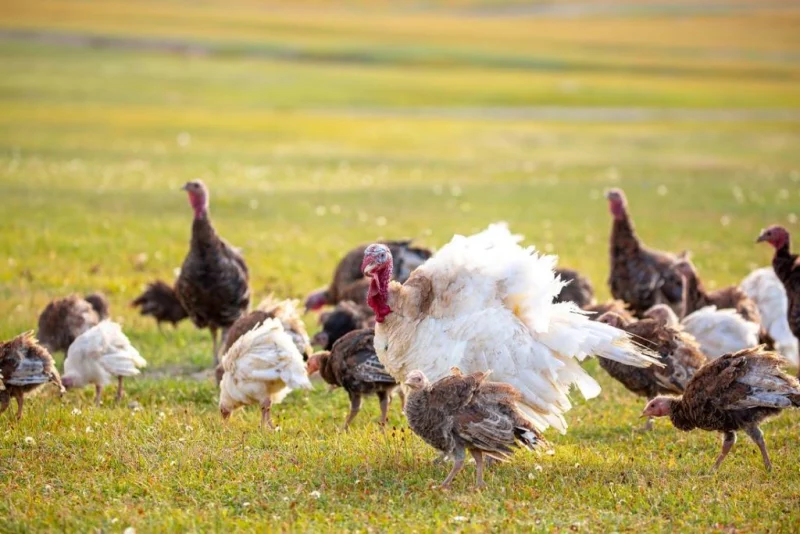
In all, we have found turkeys to be a very fun addition to our homestead. They are curious, talkative, and almost dog-like. Our Tarzan follows our peacock, James, all over the place and is a constant source of amusement. Since adding the turkey poults this spring, Tarzan has become even funnier. He struts all the time for the little turkeys and is very regal and majestic looking. If you’re on the fence about raising turkeys, I highly recommend giving it a try!
Frequently Asked Questions
Are turkeys harder to raise than chickens?
Turkeys are not much harder, but poults are more fragile than chicks. They are sensitive to heat and light changes, and the first three days need extra supervision. Once past the brooder stage, many Keepers find turkeys easy, curious and good foragers.
How do you get baby turkeys to drink?
Poults often need more encouragement to drink than chicks. Some Keepers drop a few clean, colored marbles into the waterer, since the curious poults peck at them and end up drinking more. Check that every poult is drinking in the first days.
How much space do turkeys need compared to chickens?
Turkeys get much bigger than chickens, so they need more room in a coop and run. They scratch less than chickens, which can keep housing a bit cleaner. They like to roost high, and larger birds may need help reaching the roost.
When do turkeys start laying eggs?
Hens take longer to mature than chickens, anywhere from seven months up to a year. After that they lay about two to three eggs a week, not nearly daily like many chickens. The eggs are larger, creamy white and speckled with a tougher shell, and they are safe to eat.
Can turkeys eat chicken feed?
Turkeys are meant to eat a higher protein diet than chickens, and game bird feed is the usual choice. Some Keepers feed turkeys the same feed as their chickens and let them forage to fill the gap. If you are raising turkeys for meat, match the feed protein to the bird’s age.
Can turkeys live with chickens?
Many Keepers run turkeys in a mixed flock with chickens and other birds. Plan for the turkeys’ larger size and extra space needs, and watch how the birds get along. Ask a poultry-experienced veterinarian about flock health practices for mixed species.