Some American breeds came over with the settlers. The Wyandotte came from here. Developed in New York and named for the Wyandot people, it is a true American original, a breed Americans created rather than imported. Week four of our Founding Flocks series belongs to the bird that wears lace and shrugs off winter.
Top 3 Takeaways
- An American original. The Wyandotte was developed in New York, which makes it one of the breeds that America can call its own creation rather than an import.
- Built for cold. A low rose comb that resists frostbite and a dense, well-rounded body make it one of the most winter-hardy breeds in the backyard. It keeps laying when the weather turns.
- Beautiful and useful. Best known for its laced feathers, the Silver Laced Wyandotte lays about 245 cream-colored eggs a year on a calm, friendly 5 to 6 pound frame.
The 7 founding breeds of the American backyard
We are profiling one a week from now until America’s 250th birthday. Here is the full All-American lineup, with four down and three to go:
- Dominique. America’s oldest breed, traced to roughly 1750. Calm, sociable, and bred to last. The fastest way to tell it from a Barred Rock is the rose comb. Lays about 245 medium brown eggs a year. It’s the subject of our first feature below.
- Rhode Island Red. Developed in the late 1800s in the country’s smallest state and now famous worldwide, laying around 265 eggs a year and parenting half the hybrids in the modern hen house. Two out of three keepers in our survey have raised one. No other breed on this list comes close.
- Barred Plymouth Rock. The black-and-white striped farm hen most people picture when they hear the word “chicken.” Tight feathering, a broad deep chest, and a steady, unbothered temperament. About 250 large brown eggs a year.
- Wyandotte. An American original, known for laced feathers that look almost frosted and a cold-friendly rose comb. A handsome dual-purpose bird that shrugs off winter.
- Jersey Giant. Born in New Jersey and still one of the largest breeds you can keep. Slow to mature, at about six months, but gentle, friendly, and a steady source of large brown eggs.
- New Hampshire. Refined in New England from Rhode Island Red stock for faster growth and dependable laying. A quiet, no-drama dual-purpose bird.
- Delaware. Developed in 1940 in the state it is named for. White with black-laced hackles, quick to mature, calm, and good for about 260 large brown eggs a year.
Breed of the Week: The Wyandotte
If the Rhode Island Red modernized the American backyard and the Barred Rock defined how it looked, the Wyandotte proved an American breed could be both gorgeous and tough.
The Wyandotte is an American original in the truest sense: a breed shaped on this soil for this climate. From the start it was a dual-purpose farm bird meant to take a northern winter without missing a beat, and more than a century later that is still exactly what it does.
What makes the Wyandotte great
Temperament. Wyandottes are calm, friendly birds. They settle into a backyard flock without fuss, which makes them an easy choice for families and first-time Keepers alike.
Eggs. A Silver Laced Wyandotte lays about 245 cream-colored eggs a year, and it keeps laying through the winter when many breeds slow down.
Cold hardiness. This is the Wyandotte’s signature. Its low rose comb has less surface to freeze, and its dense, well-rounded body holds heat. The catalog calls the Wyandotte one of the most winter-hardy breeds, and northern Keepers have leaned on it for generations.
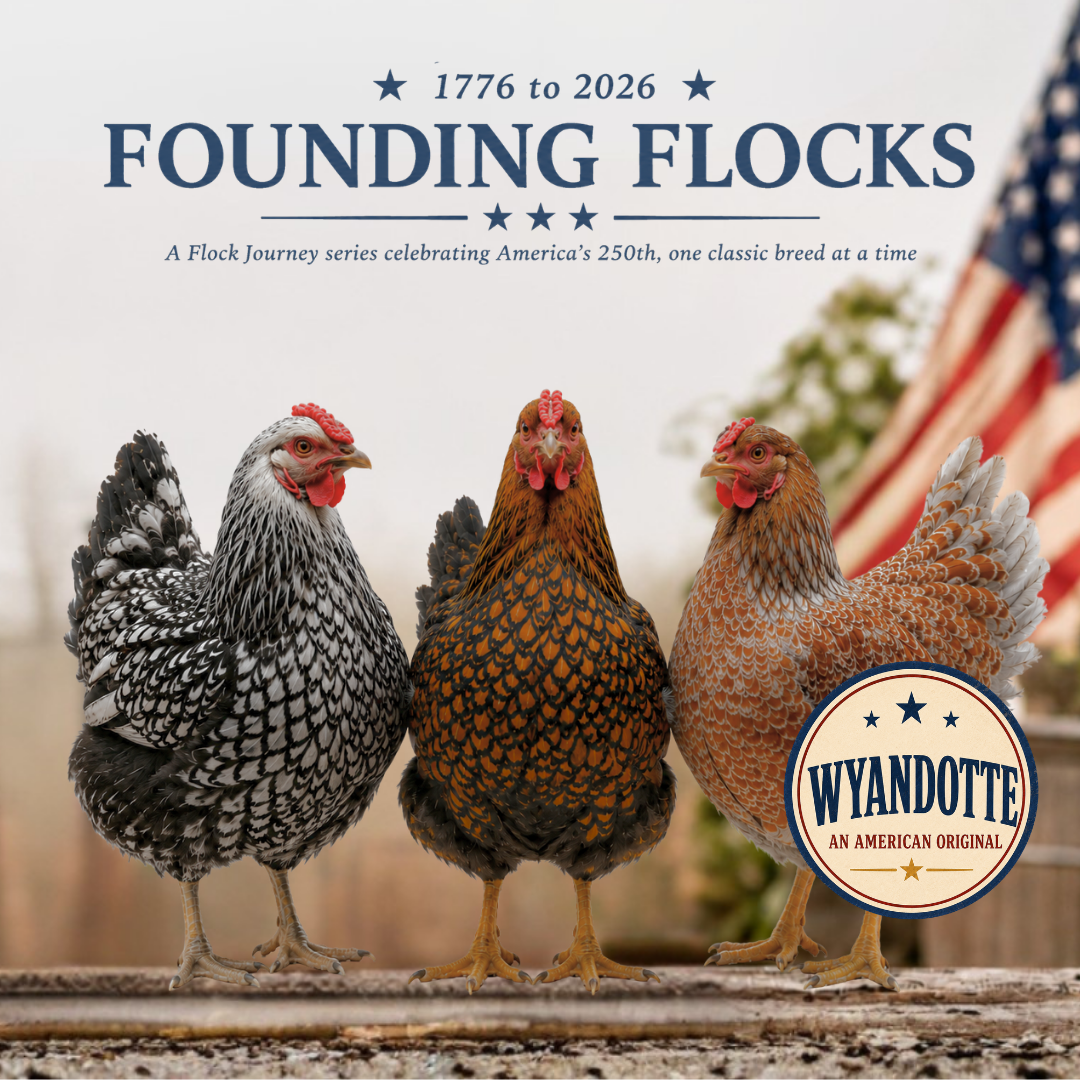
Looks. Few backyard birds are as striking. The laced pattern, a clean base color edged with a darker outline on every feather, gives the Wyandotte an almost frosted, tailored look.
Build. At a mature 5 to 6 pounds, the Silver Laced Wyandotte is an easy size to manage and sturdy enough to be a true dual-purpose bird.
One breed, a closet full of colors
Part of the Wyandotte’s appeal is how many ways it comes. Hoover’s carries a full run of varieties, each tracing the same laced pattern in a different palette:
- Silver Laced Wyandotte. The original. A crisp silver base edged in black, about 245 cream eggs a year on a 5 to 6 pound frame.
- Gold Laced Wyandotte. The same laced look in warm gold, about 245 cream eggs a year.
- Columbian Wyandotte. White with a black-edged neck and one of the most winter-hardy of the bunch, about 200 cream eggs a year.
- Blue Laced Red Wyandotte. Rich red feathers edged in soft blue, about 200 cream eggs a year.
Where to find Wyandottes
Wyandottes are a Founding Flocks favorite for good reason, and they are part of Hoover’s complete selection of backyard breeds. You can browse the full lineup and order at hoovershatchery.com, and you will find the whole Founding Flocks series, plus breed guides for every stage of keeping, on FlockJourney.
Frequently asked questions about the Wyandotte
Where did the Wyandotte chicken come from? The Wyandotte was developed in New York and is considered an American original. It is named for the Wyandot people and was bred as a dual-purpose farm chicken suited to cold climates.
Are Wyandottes cold hardy? Yes. The Wyandotte is one of the most winter-hardy backyard breeds. Its low rose comb resists frostbite and its dense, rounded body holds heat, so it keeps laying through cold weather.
How many eggs do Wyandottes lay? A Silver Laced Wyandotte lays about 245 cream-colored eggs a year. Egg numbers vary by variety, with most Wyandottes laying between about 200 and 245 eggs a year.
What color eggs do Wyandottes lay? Wyandottes lay cream-colored eggs.
What is the difference between Wyandotte varieties? Wyandottes share the same laced feather pattern and calm temperament but come in different colors, including Silver Laced, Gold Laced, Columbian, and Blue Laced Red. Mature weights run about 5 to 8 pounds depending on the variety.
Coming up next…
Next week we meet a bird that grows fast and lays dependably, all while catching your eye with its beautiful coloring: the Jersey Giant. Until then, Wyandottes are ready for your backyard. Learn more or add them to your flock at www.hoovershatchery.com/
FlockJourney is brought to you by Hoover’s Hatchery, the nationwide leader in backyard poultry. For more than 80 years, Hoover’s has lived its values of Excellence, Tenacity, Servitude, Humility, and Ingenuity while 100% focused on backyard poultry. From chickens, ducks, and pheasants, to turkeys, geese, guineas, quail, bantams, and rare breeds, Hoover’s has the best variety and the highest quality genetics in the industry. Find Hoover’s chicks at your local farm store or shop online at www.hoovershatchery.com