Top 3 Takeaways
- The Rhode Island Red is America’s most-raised backyard hen. In a recent Hoover’s survey of 253 backyard keepers, 66% had raised one. That’s two of every three keepers, and no other brown egg layer comes close.
- You may already be raising its descendants. The Red Star, Black Sex-Link, Cinnamon Queen, and ISA Brown all trace back to a Rhode Island Red parent, and the New Hampshire was refined straight from Rhode Island Red stock. One breed from one small state is the genetic backbone of the modern hen house.
- It delivers exactly what keepers say they want. About 265 large brown eggs a year, a gentle temperament, and the cold hardiness to lay through an Iowa winter. When keepers choose a laying breed, 65% rank production reliability first and 56% rank cold and heat hardiness. The Rhode Island Red checks every box.
The breed from the smallest state that changed everything
Last week we started before the beginning, with the Dominique, the oldest chicken in America. This week we jump ahead about a century to the breed that reshaped the American backyard from the ground up.
Rhode Island may be the smallest state in the union, but the bird developed there in the late 1800s made some of the biggest changes in the history of chicken keeping. The Rhode Island Red could lay about 265 eggs a year at a time when that kind of output was almost unheard of, and word traveled fast. Within a generation it was famous worldwide, and breeders everywhere reached for Rhode Island Red roosters to build better layers. They are still reaching for them today.
Breed of the Week: The Rhode Island Red
If the Dominique is the bird that fed colonial America, the Rhode Island Red is the bird that modernized it.
It was developed in the late 1800s in Rhode Island, and its calling card was production. These glossy mahogany hens with black tail feathers could lay around 265 large brown eggs a year, and they did it reliably, in heat and in cold, without much fuss. That mix of output and toughness made the Rhode Island Red famous worldwide and turned it into the breed other breeds are built from.
What makes the Rhode Island Red great
Temperament. Rhode Island Reds are gentle, confident, and easy to have around. They’re curious without being needy, which makes them a favorite for families and first-time keepers alike.
Eggs. Expect about 265 large brown eggs a year. That’s one of the most dependable baskets you can ask for from a standard breed, and it’s a big reason the Rhode Island Red has stayed at the top of the backyard for more than a century.
Build. At a mature 6 to 7 pounds with a single comb and that signature glossy mahogany plumage, the Rhode Island Red is a true dual-purpose bird. It’s hardy in all conditions and built to keep laying through the short, dark days of winter, when lighter breeds slow down.
The bird behind half your favorite layers
Here’s something most keepers don’t realize: if you’ve raised a popular brown egg layer, there’s a good chance you’ve already raised a Rhode Island Red, or at least its child.
The Rhode Island Red rooster is the go-to parent for the modern hybrid layer. Cross him with a Silver Laced Wyandotte hen and you get the Cinnamon Queen. Cross him with a Delaware hen and you get the Red Star, a bird that can push past 320 eggs a year. Cross a Barred Rock hen with a Rhode Island Red rooster and you get the Black Sex-Link, which carries the Rock’s easygoing temperament and the Red’s winter grit. Even the ISA Brown, the workhorse brown layer in backyards everywhere, traces its line back to Rhode Island Red stock. And the New Hampshire, another breed in this very series, was refined directly from Rhode Island Reds.
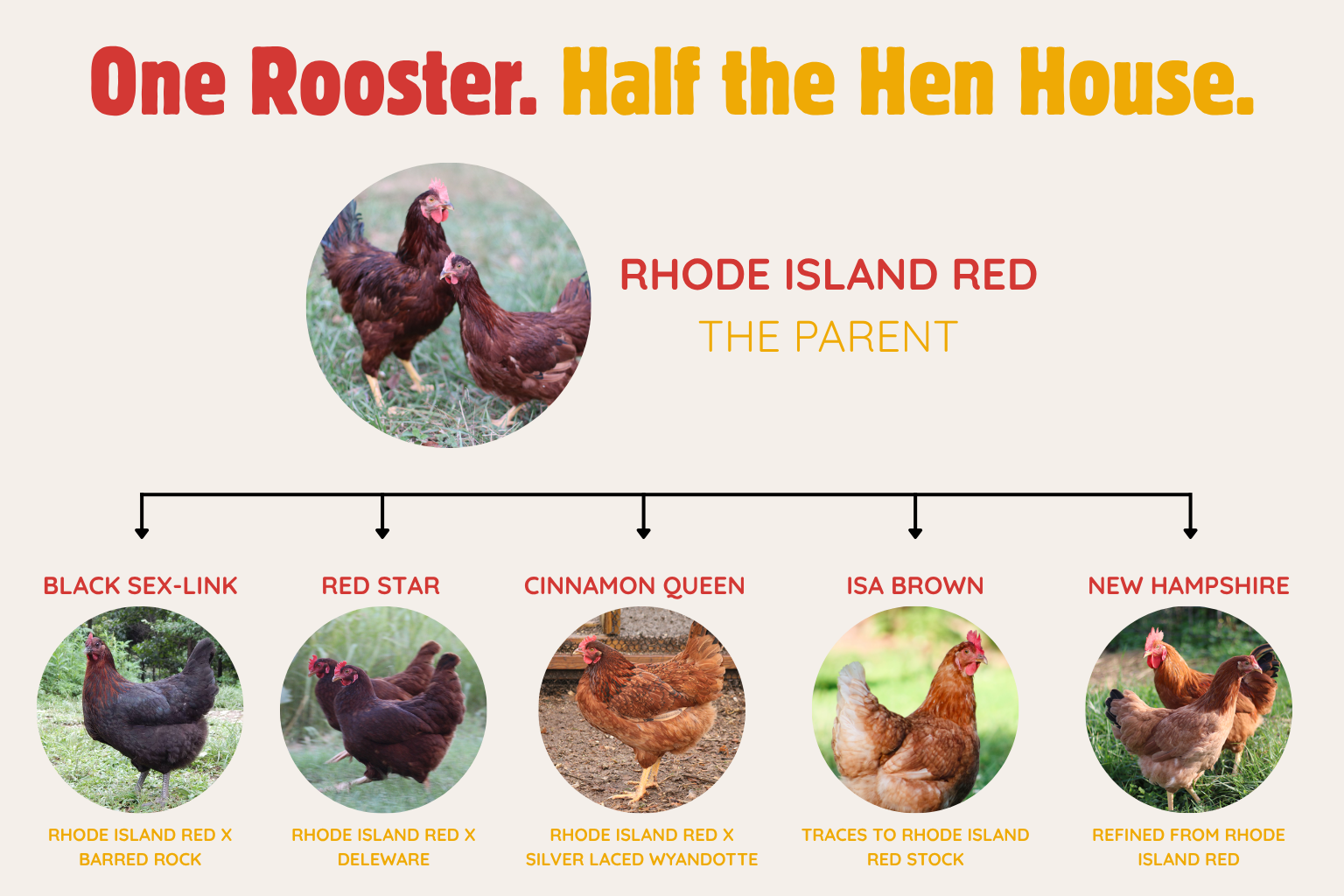
In our survey, the three most commonly raised brown egg layers were the Rhode Island Red at 66%, the ISA Brown at 47%, and the Cinnamon Queen at 27%. Look closely and you’ll notice something: all three trace back to the same small-state rooster. One breed from Rhode Island quietly stands behind a huge share of the eggs in American backyards.
Heritage or hybrid? Why keepers come back to the original
Those hybrid descendants are spectacular layers, and plenty of keepers love them. But our survey keepers told us something worth hearing: high-output hybrids tend to burn bright and fade, with laying often dropping off at two or three years. The Rhode Island Red is the heritage original they all came from, and it paces itself. You trade a little peak output for a hen that keeps laying, and keeps its personality, for years. If you want the genetics that started it all, you raise the source, not the copy.
Rhode Island Red or New Hampshire? How to tell them apart
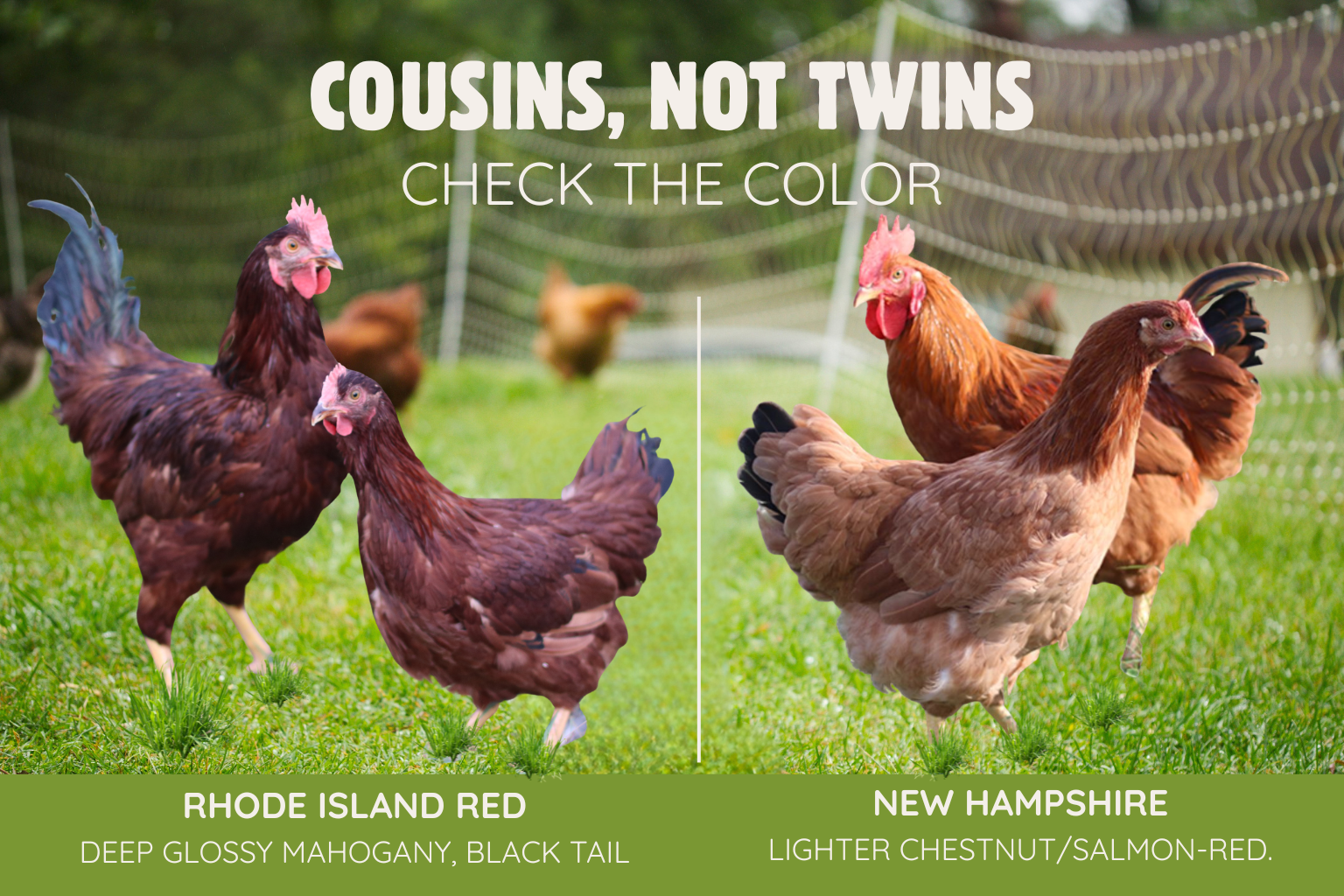
Because the New Hampshire was refined straight from Rhode Island Red stock, the two can look like cousins, and they are. The tell is the color. A Rhode Island Red is deep, dark, glossy mahogany, almost a burnished brick red, with black in the tail. A New Hampshire is noticeably lighter, a brighter chestnut or salmon-red that catches the sun. Once you’ve seen them side by side, the Red reads as the richer, deeper bird every time.
Who the Rhode Island Red is for
If this is your first flock, the Rhode Island Red is one of the safest, most rewarding birds you can choose. It’s hardy, friendly, forgiving, and it will fill your egg basket while you learn.
If you’ve kept chickens for years, this is the breed that connects your backyard to the whole history of American egg production. It’s the standard every brown layer is measured against, and it earns its keep season after season.
And if you want the most influential American chicken there is, the Rhode Island Red has a claim no hybrid can match. Half the hen house descends from it. This is the original.
FAQ
What is the most popular backyard chicken breed in America?
The Rhode Island Red. In a recent Hoover’s survey of 253 backyard keepers, 66% had raised one, making it the most commonly raised brown egg layer in American backyards.
How many eggs does a Rhode Island Red lay per year?
A Rhode Island Red lays about 265 large brown eggs a year. Its combination of high output and cold hardiness is what made the breed famous worldwide.
Where did the Rhode Island Red come from?
The Rhode Island Red was developed in the late 1800s in Rhode Island, the smallest U.S. state. Its egg production made it world-famous and it became the parent of several modern hybrid layers.
What hybrid breeds come from the Rhode Island Red?
Rhode Island Red roosters are the parent of many popular hybrids, including the Cinnamon Queen, Red Star, and Black Sex-Link. The ISA Brown traces to Rhode Island Red stock, and the New Hampshire was refined directly from it.
Are Rhode Island Reds good for beginners?
Yes. Rhode Island Reds are gentle, hardy, and dependable layers that adapt easily to a backyard, which makes them one of the best breeds for first-time keepers.
How do you tell a Rhode Island Red from a New Hampshire?
Check the color. A Rhode Island Red is deep, glossy mahogany with black tail feathers, while a New Hampshire is a lighter chestnut or salmon-red. The New Hampshire was refined from Rhode Island Red stock, so their builds are similar and color is the clearest difference.
Raise a piece of American history
At Hoover’s Hatchery, we think there’s no better way to celebrate America 250 than starting or growing a flock of your own. The Rhode Island Red is a fine place to begin. It’s the bird that built the modern backyard, it’ll fill your basket, and it carries 150 years of American know-how in every feather. And it fits in your yard.
The 7 founding breeds of the American backyard
We’re profiling one a week from now until America’s 250th birthday. Here’s the full All-American lineup, with two down and five to go:
- Dominique. America’s oldest breed, traced to roughly 1750. Calm, sociable, and bred to last. The fastest way to tell it from a Barred Rock is the rose comb. Lays about 245 medium brown eggs a year. It’s the subject of our first feature below.
- Rhode Island Red. Developed in the late 1800s in the country’s smallest state and now famous worldwide, laying around 265 eggs a year and parenting half the hybrids in the modern hen house. Two out of three keepers in our survey have raised one. No other breed on this list comes close.
- Barred Plymouth Rock. The black-and-white striped farm hen most people picture when they hear the word “chicken.” Tight feathering, a broad deep chest, and a steady, unbothered temperament. About 250 large brown eggs a year.
- Wyandotte. An American original, known for laced feathers that look almost frosted and a cold-friendly rose comb. A handsome dual-purpose bird that shrugs off winter.
- Jersey Giant. Born in New Jersey and still one of the largest breeds you can keep. Slow to mature, at about six months, but gentle, friendly, and a steady source of large brown eggs.
- New Hampshire. Refined in New England from Rhode Island Red stock for faster growth and dependable laying. A quiet, no-drama dual-purpose bird.
- Delaware. Developed in 1940 in the state it is named for. White with black-laced hackles, quick to mature, calm, and good for about 260 large brown eggs a year.
Coming up next…
Next week we meet the bird most people picture when they hear the word “chicken,” the black-and-white farm classic: the Barred Plymouth Rock. Until then, the hen that started half the hen house is ready for your backyard. Learn more or add them to your yard now at www.hoovershatchery.com/rhode-island-red
FlockJourney is brought to you by Hoover’s Hatchery, the nationwide leader in backyard poultry. For more than 80 years, Hoover’s has lived its values of Excellence, Tenacity, Servitude, Humility, and Ingenuity while 100% focused on backyard poultry. From chickens, ducks, and pheasants, to turkeys, geese, guineas, quail, bantams, and rare breeds, Hoover’s has the best variety and the highest quality genetics in the industry. Find Hoover’s chicks at your local farm store or shop online at www.hoovershatchery.com.