FlockJourney America 250 Series, Part 6: The New Hampshire, the breed from the state that made America official.
Top 3 Takeaways
- New Hampshire is the state that wanted its own chicken. New Hampshire’s poultry breeders watched Rhode Island get a breed named for it and decided to create their own. By the mid-1930s they had, by refining Rhode Island Red stock in the Granite State into a faster-growing, dependable bird all their own.
- It is a working bird, bred to do two jobs well. The New Hampshire lays about 240 brown eggs a year and grows quickly enough that it was a major broiler breed before modern hybrids arrived. If you want eggs and meat from one calm, practical flock, this is a strong pick.
- There is no better day to meet it. New Hampshire cast the ninth and deciding vote to ratify the Constitution, the vote that made it the law of the land. On America’s 250th, the breed named for that state earns its place in the lineup.
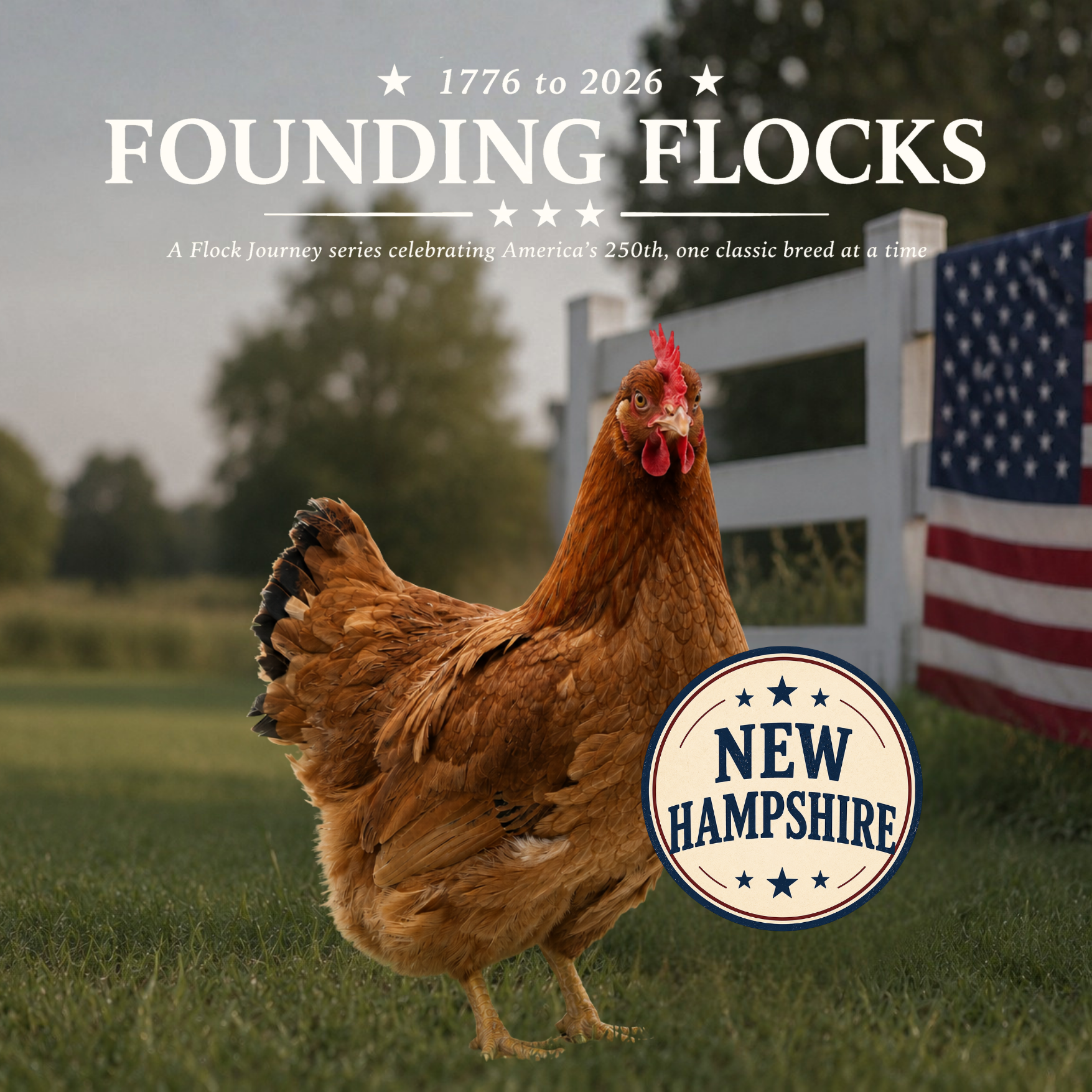
Today, America turns 250
The parades are underway and the fireworks are loaded. Two and a half centuries after a handful of colonies decided to become independent, the United States is celebrating its 250th birthday. For the past several weeks, we have been marking it the way we know best, with the chickens that helped build the American backyard.
So far this series has traveled from the oldest breed on the continent to the biggest bird you can keep. Today we land on a breed with a claim that fits the date perfectly. The Constitution did not take effect the moment it was written. It needed nine states to say yes. New Hampshire was the ninth. The vote cast in the Granite State on June 21, 1788 is the one that turned a document into a country. It is only right that the breed carrying that state’s name shows up on the 4th of July.
The 7 founding breeds of the American backyard
Each of these was either developed on American soil or earned its reputation here. Here is the full lineup, with New Hampshire featured below.
- Dominique. America’s oldest breed, traced to roughly 1750. Calm, sociable, and bred to last. About 245 medium brown eggs a year.
- Rhode Island Red. Developed in the late 1800s in the country’s smallest state and famous worldwide. Around 265 brown eggs a year, and the parent of half the hybrids in the modern hen house.
- Barred Plymouth Rock. The black-and-white striped farm hen most people picture when they hear the word chicken. Steady and unbothered, about 250 large brown eggs a year.
- Wyandotte. An American original with laced feathers and a cold-friendly rose comb. A handsome dual-purpose bird that shrugs off winter.
- Jersey Giant. Born in New Jersey and still one of the largest breeds you can keep. Slow to mature but gentle, friendly, and a steady source of large brown eggs.
- New Hampshire. Refined in the Granite State from Rhode Island Red stock for faster growth and dependable laying. A practical, no-drama dual-purpose bird, and today’s feature.
- Delaware. Developed in 1940 in the state it is named for. White with black-laced hackles, quick to mature, and calm. The finale of our series.
Breed of the Week: The New Hampshire
Every state wants something to call its own. In the early 1900s, New Hampshire’s poultry breeders looked south at Rhode Island, which already had a world-famous chicken with its name on it, and decided the Granite State deserved one too.
So they got to work with Rhode Island Red stock and selected, generation after generation, for the traits a working farm actually needed: quicker growth, earlier maturity, and dependable laying. By the mid-1930s they had a distinct breed, lighter in color than its Rhode Island parent, with soft rusty-red feathers instead of deep mahogany. They named it, plainly and proudly, the New Hampshire. Before modern hybrids took over the meat business, it was one of the most important broiler breeds in the country.
What makes the New Hampshire great
Temperament. The New Hampshire is a practical, even-tempered bird, the no-drama type that gets on with the business of being a good backyard hen. That easygoing nature makes it a comfortable choice for a family flock and for a first-time Keeper.
Eggs. Expect about 240 medium brown eggs a year. That is a dependable, year-round basket, and it is exactly the kind of steady production Keepers tell us they want most.
Build. At a mature 6 to 7 pounds with a single comb, the New Hampshire is a true dual-purpose bird. It grows faster than most heritage breeds, which is what made it a broiler favorite, so it gives you a real choice: keep the hens for a full basket of eggs, or raise the flock for the table. New England winters shaped this bird, so cold weather does not faze it.
Is the New Hampshire right for you?
If you want one calm, hardworking breed that delivers both eggs and meat without fuss, the New Hampshire belongs on your short list. It suits the Keeper who values reliability over novelty, who wants a bird that matures quickly and lays steadily, and who likes the idea of a flock with a little American history in it. In our recent survey of 253 backyard Keepers, two out of three had raised the New Hampshire’s parent, the Rhode Island Red. The New Hampshire offers that same trusted, all-American foundation, in a bird that gets to work a little sooner.
FAQ
What is a New Hampshire chicken?
The New Hampshire is an American dual-purpose breed developed in the Granite State by the mid-1930s from Rhode Island Red stock. It was selected for faster growth and dependable laying, and it was an important broiler breed before modern hybrids. It lays about 240 medium brown eggs a year.
How many eggs does a New Hampshire chicken lay?
A New Hampshire hen lays about 240 medium brown eggs per year, a steady, year-round supply for a backyard flock.
What is the difference between a New Hampshire and a Rhode Island Red?
The New Hampshire was developed from Rhode Island Red stock, so they are closely related. The New Hampshire has lighter, rusty-red feathers rather than the Rhode Island Red’s deep mahogany, and it was bred to grow faster and mature earlier. The Rhode Island Red lays a bit more, around 265 eggs a year.
Are New Hampshire chickens good for beginners?
Yes. New Hampshires are calm, even-tempered, cold-hardy, and dependable layers, which makes them a comfortable choice for a first flock.
Is the New Hampshire a good meat bird?
Yes. The New Hampshire grows faster than most heritage breeds and was a leading broiler breed before modern hybrids, which is what makes it a genuine dual-purpose bird for eggs and meat.
Raise a piece of American history
At Hoover’s Hatchery, we believe starting or keeping a backyard flock is one of the best ways to celebrate America 250. There is something fitting about marking the country’s founding with a bird that helped feed it, in a yard that is your own. On a day built on a decisive vote for independence, the New Hampshire is a fine bird to have out back. Learn more or add them to your yard at www.hoovershatchery.com/new-hampshire
Coming up next
One breed remains. To close the series, we head to the first state to ratify the Constitution for the bird that completes the All-American Backyard Lineup: the Delaware. Until then, happy Independence Day, and happy 250th!
FlockJourney is brought to you by Hoover’s Hatchery, the nationwide leader in backyard poultry. For more than 80 years, Hoover’s has lived its values of Excellence, Tenacity, Servitude, Humility, and Ingenuity while 100% focused on backyard poultry. From chickens, ducks, and pheasants, to turkeys, geese, guineas, quail, bantams, and rare breeds, Hoover’s has the best variety and the highest quality genetics in the industry. Find Hoover’s chicks at your local farm store or shop online at www.hoovershatchery.com.